|
|
|
Match
Summary |
|
|
  Officials
from Netherlands Officials
from Netherlands |
Scotland |
Type |
England |
Referee
(-) - Laurens van
Ravens
x (-).
Linesmen -
W.J.M. Schalks (red flag) and
J. Bijleveld (orange flag).
Prior to this
match, the crowd were entertained with various other sports, such as cycle
racing between Scotland and England, as well as short-distance running
(half-mile and quarter-mile).
This match was played two months
earlier than usual because it falls under the jurisdiction of UEFA.
|
|
Goal Attempts |
|
|
|
Attempts on Target |
|
|
|
Hit Bar/Post |
|
|
|
Corner Kicks Won |
|
|
|
Offside Calls Against |
|
|
|
Fouls Conceded |
|
|
|
Possession |
|
|
|
 Scotland
Team Scotland
Team |
| |
|
Rank: |
No official ranking;
EFO ranking
ELO rating 17th to 16th |
Colours: |
Made by Umbro -
blue crew-necked jerseys with white collars/cuffs, white shorts, blue socks
with red tops. |
|
Capt: |
John Greig |
Manager:
Trainer: Walter McRae (Kilmarnock FC) |
Robert Brown, 44 (19 March 1923), appointed 6 February
1967,
fifth match, W 2 - D 1 - L 2 - F 7 - A 8.
team chosen on Tuesday, 21 February 1968. |
|
Scotland
Lineup |
|
|
Simpson, Ronald C. |
37 |
11 October 1930 |
G |
The Celtic FC |
4 |
6ᵍᵃ |
|
2 |
Gemmell, Thomas |
24 |
18 October 1943 |
RB |
The Celtic FC |
6 |
0 |
|
3 |
McCreadie, Edward G. |
27 |
15 April 1940 |
LB |
Chelsea FC, England |
14 |
0 |
|
4 |
McNeill, William |
27 |
2 March 1940 |
CHB |
The Celtic FC |
21 |
1 |
|
5 |
McKinnon, Ronald |
27 |
20 August 1940 |
CHB |
Rangers FC |
12 |
1 |
|
6 |
Greig, John |
25 |
11 September 1942 |
CM |
Rangers FC |
24 |
3 |
|
7 |
Cooke, Charles |
25 |
14 October 1942 |
RM |
Chelsea FC, England |
5 |
0 |
|
8 |
Bremner, William
J. |
25 |
9 December 1942 |
LM |
Leeds United AFC, England |
12 |
0 |
9 |
Hughes, John |
24 |
3 April 1943 |
CF |
The Celtic FC |
6 |
1 |
|
10 |
Johnston, William M. |
21 |
19 December 1946 |
OL |
Rangers FC |
6 |
0 |
|
11 |
Lennox, Robert |
24 |
30 August 1943 |
OR |
The Celtic FC |
5 |
2 |
|
unused substitute: |
goalkeeper:-Bobby Clark (Aberdeen FC) |
|
reserves: |
Peter Cormack (Hibernian FC), Jimmy Johnstone (The Celtic FC) |
|
team notes: |
Manager Bobby Brown played for Scotland against England in April 1952.
John Hughes replaced original choice centre-forward, Alan Gilzean. |
|
|
|
4-3-3 |
Simpson -
Gemmell, McKinnon, McNeill, McCreadie -
Cooke, Greig, Bremner -
Lennox, Hughes, Johnston. |
|
Averages: |
Age |
- |
Appearances/Goals |
- |
- |
|
|
|
|
flg.jpg) England
Team England
Team |
| |
|
Current World Champions |
Colours: |
The 1965 Umbro
home uniform
- White crew-necked jerseys, blue shorts, white socks. |
|
Rank: |
No official ranking;
EFO ranking
ELO rating 1st |
|
Capt: |
Bobby Moore, fortieth captaincy |
Manager: |
Sir
Alfred Ernest Ramsey, 48 (22 January 1920), appointed
25 October 1962, effective part-time 31 December, full from May 1963.
54th match, W 35 - D 12 - L 7 - F 126 - A 59.
team chosen on the day of the match |
|
England
Lineup |
|
1 |
Banks, Gordon |
30 |
30 December 1937 |
G |
Stoke City FC |
41 |
39ᵍᵃ |
|
2 |
Newton, Keith |
26 |
23 June 1941 |
RB |
Blackburn Rovers FC |
6 |
0 |
|
3 |
Wilson, Ramon |
33 |
17 December 1934 |
LB |
Everton FC |
59 |
0 |
|
4 |
Mullery, Alan P. |
26 |
23 November 1941 |
RHB |
Tottenham Hotspur FC |
7 |
0 |
|
5 |
Labone, Brian |
28 |
23 January 1940 |
CHB |
Everton FC |
6 |
0 |
|
6 |
Moore, Robert F.C. |
26 |
12 April 1941 |
CHB |
West Ham United FC |
57 |
2 |
|
7 |
Ball, Alan |
22 |
12 May 1945 |
OL |
Everton FC |
23 |
4 |
|
8 |
Hurst, Geoffrey |
26 |
8 December 1941 |
OR |
West Ham United FC |
18 |
9 |
|
850 |
9 |
Summerbee, Michael G. |
25 |
15 December 1942 |
CF |
Manchester City FC |
1 |
0 |
|
10 |
Charlton, Robert |
30 |
11 October 1937 |
AM |
Manchester United FC |
82 |
43 |
|
11 |
Peters, Martin S. |
24 |
8 November 1943 |
LHB |
West Ham United FC |
16 |
6 |
|
unused substitute: |
goalkeeper:-Gordon West
(Everton FC) |
|
reserves: |
Cyril Knowles (Tottenham Hotspur FC), Norman Hunter (Leeds United AFC) |
|
team notes: |
Manager Alf Ramsey played against Scotland in four matches from 1950
until 1953. |
|
|
|
4-3-3 |
Banks
-
Newton, Labone, Moore, Wilson -
Mullery, Charlton, Peters -
Hurst, Summerbee, Ball |
|
Averages: |
Age |
- |
Appearances/Goals |
- |
- |
|
England teams v. Scotland: |
Sub: |
|
1967: |
Banks |
Cohen |
Wilson |
Stiles |
J.Charlton |
Moore |
Ball |
Greaves |
R.Charlton |
Hurst |
Peters |
Bonetti |
|
1968: |
Banks |
Newton |
Wilson |
Mullery |
Labone |
Moore |
Ball |
Hurst |
Summerbee |
R.Charlton |
Peters |
West |
|
|
|
|
Match Report
by Mike Payne |
|
England went into this vital match knowing that a draw would be enough
to see them through as the group winners of the European Nations
Championship matches. Of course, it would also win them the Home
Championship, so there was much at stake.
As in any England-Scotland clash there was
'no quarter given nor received' and right from the 'off' it was an
all-out battle. But, after the initial exchanges, England scored the
goal they needed. It came with 20 minutes gone and was a beauty. It
began with a bad throw-out by Simpson. Ray Wilson won the ball in the
air, beating Johnston, and Mike Summerbee then flicked it sideways to
Martin Peters. The England number-11 once again showed his vision by
being in the right place at the right time to flash home a superb
cross into the top corner of Simpson's net from the edge of the box.
The goal put England well and truly into the 'driving seat' and they had
chances to 'sew' the game up in the next ten minutes. Playing open,
attacking football and allowing the ball to do the work, their tactics
were superior than the Scots' close-dribbling game. Unfortunately, Peters
and others let the chances slip by and it gave Scotland the chance to
fight back.
The man who did as much as anyone to revitalise Scotland was the midfield
player Charlie Cooke. For the quarter of an hour before the interval, he
turned on the style and dazzled the crowd with some superb skills. First,
he bemused an uncertain Gordon Banks with a wicked corner which left
Hughes with the simplest scoring chance which, to the dismay of the crowd,
he squandered. Then Cooke combined with Greig to 'tie Keith Newton into
knots' before the ball found Lennox. The winger centred and there was
Hughes to atone for his earlier miss by heading past the scrambling Banks.
The morning rain on top of the bone-hard pitch certainly made the
conditions difficult but Cooke's inspiration almost brought another goal
when his superb through-pass found Greig. Fortunately for England, the
Scotland skipper shot just wide. England, after their fine start, were
relieved to reach the interval without further mishap. The break helped
them enormously as in it they discussed the problem of Cooke's promptings
and found an answer.
In the second half Cooke was continually boxed in by England players and
was gradually forced square. As a result he was far less effective. The
Scottish forwards were starved of service and faded, giving England the
chance to reassert themselves. This time they held on to the initiative.
Bobby Moore dominated at the back, Alan Mullery was aggressive in midfield
and Bobby Charlton exciting in his unique and graceful way.
Alan Ball was tireless and Peters ever-dangerous when making openings for
himself. Peters was desperately unlucky when one fine shot cannoned back
off a post. Overall, England deserved the draw they wanted but doubts
about the jittery performance of Banks, Newton and Brian Labone left a few
questions for Sir Alf Ramsey to answer.
England now went on to play a two-legged quarter-final against Spain.
|
|
Match Report
by Norman Giller |
|
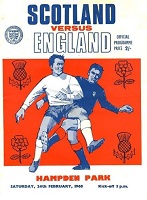 England needed a draw to qualify for
the European
Championship quarter-finals, Scotland a win. Martin Peters
(described by Sir Alf as
"twenty years ahead of his time") produced one of
his most impressive performances for England, scoring their goal with a
superbly controlled swerving shot and going close on three other
occasions. John Hughes headed Scotland's equaliser when Gordon Banks
slipped on the treacherous surface that was a mixture of mud and ice.
Charlie Cooke had a brilliant twenty-minute spell when he ran the England
defence dizzy, but the Scottish strikers could not cash in on his creative
work. Mike Summerbee made a quietly impressive debut, and played an
important assist role in the Peters goal that stamped the passport for
England
to
play Spain in a two-legged quarter-final. England needed a draw to qualify for
the European
Championship quarter-finals, Scotland a win. Martin Peters
(described by Sir Alf as
"twenty years ahead of his time") produced one of
his most impressive performances for England, scoring their goal with a
superbly controlled swerving shot and going close on three other
occasions. John Hughes headed Scotland's equaliser when Gordon Banks
slipped on the treacherous surface that was a mixture of mud and ice.
Charlie Cooke had a brilliant twenty-minute spell when he ran the England
defence dizzy, but the Scottish strikers could not cash in on his creative
work. Mike Summerbee made a quietly impressive debut, and played an
important assist role in the Peters goal that stamped the passport for
England
to
play Spain in a two-legged quarter-final.
|
In
Other News....
|
It was on 24 February 1968 that
26-year-old Roger Payne was charged with the murder of his
wife's friend, twenty-year-old Claire Josephs in Bromley.
Her throat had been cut. Payne was convicted, three months
later, entirely on forensic evidence. Woollen fibres from
her dress had been found on Payne's clothing, even though it
had been laundered since, and traces of her rare blood type
were found in his car. He was sentenced to life
imprisonment, but absconded from day-release at an open
prison in 1991 and lived for three years at Lydney in
Gloucestershire. Calling himself Thomas Fairfax, he moved in
with a woman. Eventually, he was tracked down and returned
to prison where he continually waived his own parole
hearings. |
|
|
 Source Notes Source Notes |
TheFA.com
UEFA.com
LondonHearts.com
Original newspaper reports
Rothman's Yearbooks
Mike Payne's England: The Complete Post-War Record
(Breedon Books Publishing Company, Derby, U.K., 1993)
Norman Giller, Football Author
____________________
CG
|
 England
Football Online
England
Football Online

 419
419