|
|
|
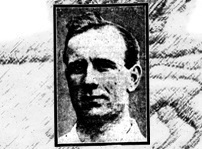
Frank
Buckley |
Derby County
FC
1 appearance, 0 goals
P 1 W 0 D 0 L 1 F 0:
A 3
0% successful
1914
captain: none
minutes played: 90 |
 |
|
Timeline |
| |
Major Franklin Charles Buckley |
|
Birth |
Tuesday, 3 October 1882 at Highfield Terrace,
Westbourne Road, in Urmston, Lancashire |
|
|
registered in Barton-upon-Irwell January-March 1883 |
|
Education |
Attended St Francis Xavier
College in Liverpool. |
|
6756 |
According to the 1891 census,
Franklin C. is the ninth of eleven children (sixth of seventh on this
census) to John and Julia Margaret (née Franklin), living at
19 Newton Street in Urmston. His father is an Army Instructor.
Joined the army in February 1900 until April 1905. |
|
|
Not on the 1901 census
(he had joined the army a year previously), but his family are living at
13 Duke Street in Rusholm area of south Manchester. His father is a drill
instructor.
His mother died during the 1904 summer. |
|
First marriage |
to Madge Robinson, on Wednesday, 4 October 1905 at Chorlton Register Office,
Lancashire, Madge herself is a widow |
|
|
registered in Chorlton October-December 1905 |
|
Children |
Frank and Madge Buckley have one son together. Jack (b.17 November
1904) |
|
other children |
Frank Buckley and Harriet Owen have one son together. Jack (b.15
February 1910).
Harriet is a servant at Lodge Farm. Jack was adopted by
the White's a year later. |
|
1257 |
According to the 1911 census,
Franklin is married to Madge with one son, Jack, and they live at Lodge
Farm in Redditch. Franklin is a farmer.
Upon his attestation, on 15
December 1914, to the 17th Middlesex Regiment (the Footballers' Battalion), his address
is stated as Burymound, Warstock in Warwickshire. |
"FOOTBALL OFFICERS
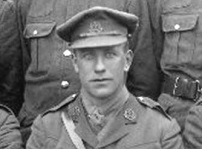 |
Among the appointments gazetted last night are those of two
well-known players, Walter Hoad and Franklin Charles Buckley, to be
temporary second lieutenants in the 17th Battalion (Football) Duke of
Cambridge's Own (Middlesex Regiment)." - The London Standard,
Thursday, 11 February 1915 |
|
"The promotion of temporary Captain Franklin C. Buckley, of the
Middlesex Regiment (Footballers Battalion) to be temporary Major was
gazetted last night." - Surrey Daily News, Thursday, 23 March 1916 |
|
"Followers of Association football will regret to learn that Major
F. C. Buckley, Middlesex Regiment, who helped to raise the Footballers'
Battalion, has been severly wounded in the shoulder. He is now in the
Bournbrook Hosital." - Sheffield Daily Telegraph, Monday, 7
August 1916 |
Could not be found on the 1921 census.
According to the Midlands Electoral Roll, Frank, along with his brother,
Christopher, in 1935, were living at Hawkesley Farm in the Northfield area
of Birmingham. |
|
|
"While staying with the Wolverhampton Wanderers team at
Newcastle-on-Tyne, where they spent the night in readiness for the match
with Sunderland. Major F. C. Buckley, secretary-manager of the Wolves,
received news by telephone of the death of his wife, Mrs. Madge Buckley,
who had been living for some time with relatives at Northfield,
Birmingham. In spite of his loss, Major Buckley decided to remain with the
team. Mrs. Buckley, who had suffered from chronic bronchitis, was a native
of Manchester, and during the war she was engaged in hospital work." - Birmingham Gazette, Monday, 24 February 1936 |
|
"FRIENDS of Major Frank Buckley,
secretary-manager of Wolverhampton Wanderers Football Club, off whom their
are many in Derby, will tender their sympathy in the bereavement that has
befallen him through the death of his wife. He was one of the mainstays of
Derby County immediately before the war, and was one of the first to join
up in 1914. Mrs. Buckley also devoted herself to war work, being
commandant of a V.A.D. hospital at Manchester, and both of them suffered
in health as a result of their strenuous labours. Mrs. Buckley has been an
invalid for some years." - Derby Evening Telegraph, Monday,
24 February 1936 |
|
Second marriage |
to
Dorothy Isabelle Davis, on Tuesday, 23 June 1936 at Wolverhampton Register Office,
Staffordshire |
|
|
registered in Wolverhampton April-June 1936 |
|
"Major Frank C. Buckley, Wolverhampton
Wanderers' Secretary-Manager, was married privately at Wolverhampton
Register Office to Miss Dorothy Isabel Davis, a member of a Wolverhampton
family." - The Sunderland Echo, Wednesday, 24 June 1936 |
|
|
The British Phone Books in 1936 revealed that
Buckley, calling himself Major Franklin C., was living on Rupert Street in Wolverhampton, and could be contacted by telephone on 22735. By 1937, he
was living at St Jude's Court on the Tettenhall Road, same number. |
|
|
According to the 1939 register, Franklin C., a secretary/manager, is now
married to Dorothy I., and are still living at 4 St. Jude's Court in Wolverhampton. |
"ROAD FINE ON MAJOR
BUCKLEY
"Maj. Franklin Charles Buckley, 99,
Boothferry-rd, Hull, manager of Hull City FC, was fined £3 at
Howden for exceeding 30mph in a car through the built-up area of Newport. Pc. Bayers said that on March
1, Maj. Buckley's speed was 48 to 50mph, which was reduced to 35mph
approaching Newport Bridge, and increased to 42mph before he passed out of
the area. Maj. Buckley wrote admitting and
regretting the offence, and said he saw no signs. He enclosed a blank cheque." -
The Daily Mail, Monday, 19 April 1948 |
|
Death |
Monday night, 21 December 1964,
at his home, Flat D, 24 Mellish Road
in
Walsall, Staffordshire |
|
aged 82 years 79 days |
registered in Walsall October-December 1964 |
|
"BUCKLEY.—On December 21, 1964,
at his home, Flat D, 24, Mellish-road, Walsall, peacefully after a
protracted illness, Franklin Charles (Major F. C. Buckley), adored husband
of Dorothy Isabelle Buckley (nee Davis)..." |
|
Obituary |
"THE
MAJOR IS DEAD
,%20Frank.png) "THE
man the older generation reckon 'made' the Wolves, Major Frank Buckley,
one of the most colourful characters in football, died at his home at
Mellish-road, Walsall, last night. He had been ill for some years. "THE
man the older generation reckon 'made' the Wolves, Major Frank Buckley,
one of the most colourful characters in football, died at his home at
Mellish-road, Walsall, last night. He had been ill for some years.
"Born 82 years ago in Urmston, Manchester, Major Buckley not only made
Wolves, but made his name during his spectacular 18 years as
secretary-manager of the Molineux club. Indeed,
he may be counted along with such as the late Herbert Chapman, of Arsenal,
among the first of the modern breed of go-ahead soccer bosses. His
transfer-market exploits and his rearing of youngsters were by-words in
the football world, and both club and game benefited as a result.
"In his long career — he was a professional with Aston Villa, Birmingham and
Derby County and an international centre-half in 1914 — Major Buckley
managed six other clubs besides Wolves. He began just after the first
world war with Norwich and then moved to Blackpool. From there he went to
Wolves for his 18-year history-making spell, which ended in 1944 when he
left Molineux for Notts County and subsequently took charge at Hull and
Leeds. His last post as a manager was at Walsall, where he was in charge
for a couple of years from April, 1953. It was then he made his home in
the town.
"But his heyday as a manager was with Wolves. The highlight
was probably his transfer of Bryn Jones to Arsenal for a then record fee
of £14,000, but he may be better remembered for the way he found the young
players. The term 'Buckley Babes' was an apt one for a man
who produced one of the youngest-ever First Division sides just before the
war. This was the beginning of a policy which was continued under
the managership of Stan Cullis, himself a Buckley discovery, and took the
club ultimately to the golden years of the 'fifties. During the Buckley
era, Wolves won promotion from the Second to the First Division, but other
honours always eluded them, albeit narrowly. The big disappointment came
as a pre-war climax with their defeat by Portsmouth in the now famous 1939
F.A. Cup final.
"But the young Wolves in that team were the cream of
the Buckley production line. They included Stan Cullis, who had become the
outstanding centre-half in the game; his fellow half-backs, Tom Galley,
from the 'Chase, and Joe Gardiner (now the club trainer) from Co. Durham,
Dick Dorsett, the former Walsall schools player, and go-ahead Denis
Westcott who was to take the club scoring record to a new figure. And in
the background were Alan Steen and Jimmy Millen, the two teenage wingers
whom the Major threw into the First Division fray when they were only
16—Mullen playing the cup semi-final. These facts are by-words with
the older faction among Wolves followers and so are the memories of the
players who, at the Major's dictate, found themselves in the first team
one week and the second, or even the third next as the Major pursued his
bold football policies. It was Major Buckley, however, who had to be
persuaded not to send Billy Wright home 'because he was too small.' But
having allowed Wright to stay, he helped start him on that most
illustrious of playing careers.
"Major Buckley became easily the most
far-sighted manager of his day, and it is no secret that Stan Cullis
achieved much of his great success for the club in the fifties with the
aid of some of the Buckley influence as he had known it as a young player.
It was Major Buckley who envisaged a British League and a European League;
it was he who felt spectators should be seated and warm when watching
their football; it was he who set the pattern for the Wolves' fast raiding
attacking style that was eventually to bring them such high honours.
By the time Buckley managerial career ended at Walsall he was in
his seventies. Some of the magic touch had gone, but not the enthusiasm
for the game. Walsall could not avoid successive re-election applications,
but neither could they take from the Major any of the memories of a half
century in the game. His brother, Mr. Chris Buckley, is chairman of Aston
Villa, for whom they both played." - Phil
Morgan - Birmingham Express & Star backpage, Tuesday, 22 December 1964.
"FAREWELL
TO MAJOR FRANK BUCKLEY—LAST OF THE GREAT MANAGERS
,%20Frank.jpg) "THE MAJOR died yesterday. He was the
last of the great managers, the impresarios, the martinets, the makers of
players and headlines. There was only one Major—Frank Buckley, the
man who ruled the Wolves with a severity that made even exacting,
demanding Stan Cullis look a humanitarian. Frank Buckley was the man who
shook the football world by announcing he would give his players monkey
gland treatment. It may only have been water, but Wolves won their way to
the 1939 Cup Final when they whipped 4—1 by outsiders Portsmouth. It
was Major Buckley who moulded the skills and the steel-tough attitude of
Stan Cullis, the man who progressed from being captain of Wolves to
captain of England, and enjoyed the glorious years as Master of Molineux
when Wolves could lick the world before he was brusquely sacked earlier
this year. "THE MAJOR died yesterday. He was the
last of the great managers, the impresarios, the martinets, the makers of
players and headlines. There was only one Major—Frank Buckley, the
man who ruled the Wolves with a severity that made even exacting,
demanding Stan Cullis look a humanitarian. Frank Buckley was the man who
shook the football world by announcing he would give his players monkey
gland treatment. It may only have been water, but Wolves won their way to
the 1939 Cup Final when they whipped 4—1 by outsiders Portsmouth. It
was Major Buckley who moulded the skills and the steel-tough attitude of
Stan Cullis, the man who progressed from being captain of Wolves to
captain of England, and enjoyed the glorious years as Master of Molineux
when Wolves could lick the world before he was brusquely sacked earlier
this year.
"It was Major Buckley who fired young Billy Wright,
relented, told him to wipe away the tears, and William Ambrose Wright
followed Stan Cullis as captain of Wolves, captain of England, and a
Soccer immortal by winning 105 international caps. And now Wright manages
Arsenal, where once upon an unforgettable age Herbert Chapman bestrode the
stately home of Highbury, a flambouyant, masterful merchant of success.
The tie-up between the Major of Wolverhampton and Arsenal made history
when the Major sold Bryn Jones to another of the fantastic, colourful
citizens of Soccer, George Allinson. The Major picked up a cheque for
£14,000, which in those days surpassed the £116,000 which Manchester
United handed over to Turin when turbulent Denis Law joined their playing
staff. George Allinson and his large cigars, his love of life. Herbert
Chapman with his fur-collared coats and the Major were characters who
unhappily will never again stride the fields of British football. Bryn
Jones, once with Arsenal, never achieved the success he had shown with
Wolves, and the war ended his chances of blending into the Highbury
immortals. Their names roll of the tongue in a way that is now beyond
recall . . . Wilson, Male, Hapgood, Crayston, Roberts, Copping, Hulme,
Bowden, Drake, James, and Bastin. I feel that the Major was rather pleased
with that deal. He must have been. He called his inseparable companion, a
wee Scottish terrier, Bryn.
"The Major was 82. When he was born in 1882
the two-handed throw-in was introduced. They used to chuck it in Rugby
fashion. It was the year before the Cup left the firm grip of the amateurs
and went out to the Provinces. It was three years before professionalism
was legalised. The Football League had not been founded. There were no
goal nets. The penalty kick had not been introduced. Major Buckley was
playing with First Division top clubs when the maximum wage was introduced
in 1901. It was £5. And the Major has gone in an age of football when the
pay is golden but the lustre of England has become dulled." - Desmond Hackett
-
Daily Express, Wednesday, 23 December 1964 |
Funeral
Thursday 11am, 24 December
1964
St. Mary & John Church, Snowhill |
|
"...Funeral service SS. Mary and John's Church, Snowhill,
Wolverhampton, Thursday, 11 a.m., followed by a cremation,
private. Flowers, please to F. Jennings and Sons, Horseley-field,
Wolverhampton." - Birmingham Express & Star, pg 6,
Tuesday, 22 December 1964. |
|
"REPRESENTATIVES of Midland football
clubs and sporting organisations attended the Wolverhampton funeral today
of Major Frank Buckley, for 18 years secretary-manager of Wolves. The
funeral service today at St. Mary and St. John Church,
Snowhill, was conducted by Canon J. F. Cleary." -
Wolverhampton Express & Star, Thursday, 24 December 1964. |
|
|
His wife, Dorothy, died on 20 September 1991 in Walsall |
|
Source |
 Douglas Lammings' An
English Football Internationalist Who's Who [1990] & Douglas Lammings' An
English Football Internationalist Who's Who [1990] & |
|
Biographies |
Football Is My Life Story
(1937);
The Major: The
Life and Times of Frank Buckley - Patrick A. Quirke
(Tempus Publishing, 2006). |
|
Playing Career |
Club(s) |
Played
junior football until he joined Aston Villa FC in April 1903 after he had
bought himself out of the army. Without any league appearances,
but one match against Corinthians in December 1904,
he joined Brighton & Hove Albion FC in 1905 in the Southern League. A year later, on 14 June 1906,
Buckley joined Manchester United FC. Joined rivals, Manchester City FC on 31 August 1907. Birmingham FC
followed on 28 July 1909. In his contract, it was stipulated that if any club offered £50,
then he should be allowed to join that club, and Derby County FC did so, and
they signed him on 24 May 1911. Despite, on 28 May
1912, Buckley placing a newspaper advert, offering his services to any
club whom would have his services. Bradford City took
Buckley on 12 May 1914, despite interest from prominent clubs, the fee was
over £1000 He retired from the game during WW1, after sustaining war
injuries to his shoulder and lungs. He did however, manage one
Southern League appearance with Norwich City FC after the war in September
1919. |
League honours
165 appearances, 7 goals |
Manchester
United FC 1906-07 three appearances
debut: 29 September 1906
Manchester United FC 1 Derby County FC 1.
Manchester City FC 1907-08 eleven appearances
debut 26
September 1907 Preston North End FC 2 Manchester City FC 4.
Birmingham FC 1909-11 55 appearances, four goals
debut
(division two): 4 September 1909 Birmingham FC 2 Oldham Athletic FC 2.
Derby County FC 1911-14 92
appearances, three goals
debut (division two): 2 September 1911 Clapton
Orient FC 3 Derby County FC 0.
Bradford City FC 1914 four appearances
debut: 1 September 1914
Manchester City FC 4 Bradford City FC 1.
last: 12 September 1914
Bradford City FC 2 Tottenham Hotspur FC 2. |
|
Club honours |
Football
League Division One third place 1907-08 (7ᵃ); Division Two winners 1911-12
(28ᵃ 1ᵍ); |
|
Individual honours |
None |
|
Distinctions |
His brother, Christopher S. Buckley also played with Aston Villa
FC, eventually becoming the club's chairman. |
|
Height/Weight |
5'
10½", 12st.
0lbs [1906].
5'
11", 13st.
7lbs [1912]. 5' 10¾",
[1914]. 5' 11" [1928]. |
|
Source |
Douglas Lammings' An English
Football Internationalist Who's Who [1990]. |
|
Management
Career |
Club(s)
League History
P
1040 - W 404 - D 239 - L 397.
,%20Major.png) |
After its directors had a clearout at their AGM, Buckley
became the
secretary~manager of Norwich City FC of
the Southern League on 19 March 1919 until July 1920. He left the game for
a while, but returned to become the manager of Blackpool FC on 12 June
1923. He resigned, and then became the secretary~manager at Wolverhampton Wanderers FC
a week later, on 30 May 1927, ahead of sixty other applicants. It was reported that he
accepted a similar role with Charlton Athletic FC in January 1933, but
remained at Molineux until he became the manager of Notts County FC on 22 February 1944
(£4500 a year). He resigned on 7 May 1946. Took up the vacant position at Hull City AFC on 18 May
until he resigned on 5 April 1948, effective from 2 May. Leeds United AFC had tried to make
Buckley their manager in the Autumn of 1947. It did not happen until he
accepted the post on 12 April 1948, commencing 3 May (£2,000 yearly salary). He then resigned
five years later, on 4 May 1953, to take over at Walsall FC until he resigned
'after a disagreement on a matter of policy'
on 7 September 1955.
It was shortly suggested that he would join his brother, Chris, at Aston
Villa FC as an assistant, but this was denied. He did, however, apply for the vacant managerial position back at Notts County FC in
January 1957. The position ultimately went to Tommy Lawton. |
Club honours |
Blackpool FC
1923-27...
Football League Division Two
fourth place
1923-24;
Wolverhampton
Wanderers FC
1927-39...
Football League Division Two winners
1931-32;
Division One
runners-up 1937-38, 1938-39; FA Cup runners-up 1938-39;
Hull City FC 1946-48...
Football League
Division Three North
fourth place
1947-48;
Leeds
United AFC 1948-53...
Football League Division Two
fifth place
1949-50, 1950-51;
FA Cup quarter-finals 1949-50
(0-1 vs. Arsenal);
Walsall FC 1952-55...
Football League
Division Thee South
23rd
1954-55 (after finishing bottom the
previous season); |
|
Individual honours |
An award for
Contribution to The Football League 2014-15; |
|
England Career |
|
Player number |
One of three who became the 376th
players (376) to appear for England. |
|
Position(s) |
Centre-half |
|
Only match |
No.
117, 14 February 1914,
England 0 Ireland 3, a British Championship match at Ayresome Park, Linthorpe, Middlesbrough, aged 31 years
134 days. |
|
Major tournaments |
British
Championship 1913-14; |
|
Team honours |
None |
|
Individual honours |
The North
(one appearance, January 1914); |
|
Distinctions |
None |
|
Beyond England |
|
Commanded the Footballers Battalion
of the Middlesex Regiment and was badly wounded in the shoulder on the Somme in
August 1916. Between 1920 and 1923, he worked for Maskell's, a
confectionary company based in London, as a commercial salesman. He was in
charge of the Royal Northumberland Fusiliers for three years up to 1936. -
An English Football Internationalists' Who's Who.
Douglas Lamming (1990). Hatton Press, p.53. |
|
The Numbers |
|
parties |
Appearances |
comp. apps |
minutes |
 |
captain |
|
1 |
1 |
1 |
90 |
0 |
none |
|
The minutes here given
can only ever be a guideline and cannot therefore be accurate, only an
approximation. |
|
P |
W |
D |
L |
F |
A |
GD |
FTS
|
CS |
FAv |
AAv |
Pts% |
W/L |
|
1 |
0 |
0 |
1 |
0 |
3 |
-3 |
1 |
0 |
0 |
3 |
0 |
-1 |
|
his only match was played in the British Championship competition,
at a home venue and against Ireland |
Tournament Record
|
British Championship Competition |
|
Type |
P |
W |
D |
L |
F |
A |
GD |
FTS |
CS |
FAv |
AAv |
Pts% |
W/L |
|
BC 1913-14 |
1 |
0 |
0 |
1 |
0 |
3 |
-3 |
1 |
0 |
0.00 |
3.00 |
0.00 |
-1 |
|
BC
All |
1 |
0 |
0 |
1 |
0 |
3 |
-3 |
1 |
0 |
0.00 |
3.00 |
0.00 |
-1 |
|
All Competition |
|
Type |
P |
W |
D |
L |
F |
A |
GD |
FTS |
CS |
FAv |
AAv |
Pts% |
W/L |
|
BC |
1 |
0 |
0 |
1 |
0 |
3 |
-3 |
1 |
0 |
0.00 |
3.00 |
0.00 |
-1 |
|
1 |
0 |
0 |
1 |
0 |
3 |
-3 |
1 |
0 |
0 |
3 |
0 |
-1 |
Match History
|
Club:
Derby County F.C. - one full appearance (90 min) |
F.A. International Select Committee - one full appearance (90 min)x |
|
apps |
match |
match details |
comp |
res. |
rundown |
pos |
|
|