|
The
England team touring on the Continent brought its engagements to a
close on Tuesday evening at Vienna with a match against Austria. The fact
that on Saturday Hungary made so gallant a fight against England aroused
intense enthusiasm among the sport-loving folk of Buda Pest, and this was
reflected in the attendance the following day, when Austria and Hungary
met on the same ground. There were several changes in the home side from
that which did duty against England the previous day, and we are assured
that it was an all-round stronger combination. We were incredulous as to
this, and as events proved rightly so. The game was contested from
kick-off to time with an earnestness and intensity that mark the struggles
between England and Scotland. When Hungary took the lead there were great
rejoicings, but Austria equalised, and thus matters remained, each side
scoring a goal. The majority of the 10,000 spectators were sadly
disappointed at the result, as a victory over the Austrians had been
confidently anticipated.
On Monday evening
a record crowd, estimated at 15,000, for a football match in Hungary
assembled on the well-appointed Millenium ground to witness the renewal of
the struggle between England and Hungary. The popularity of the visitors
ensured for them a mighty reception as they filed on the field, led by V.
J. Woodward, whose name is as familiar in big Continental cities as it is
in the Metropolis. Hungary were represented by its best eleven, and how
the home players were cheered when they dashed off at the start in
whirlwind fashion. The steadiness of the English defence was all that
could be wished, and in less than a couple of minutes the forwards were in
their stride, there were some bewildering movements, and Fleming had found
the net with a capital shot.
The exhibition of football that followed was as charming to watch as it
was effective in result. With every forward on top of his form, the haves
playing a hard game and keeping the attack well supplied with the ball,
and Crompton and Pennington presenting an impenetrable barrier to the
attempts of the Hungarians to break through, there was plenty for the
onlookers to enthuse over. They naturally were specially delighted when
the Hungarians did anything worthy of note, but they were generous in
their appreciation of the classical movements—if such a phrase be
permitted—of the visitors. Woodward put on a second goal in twelve
minutes, and Holley a third five minutes later, while the same player had
another disallowed for handling. Woodward, who has never played a finer
game, was responsible for the fourth goal with a surprise shot, and before
the interval Fleming gave his side a fifth.
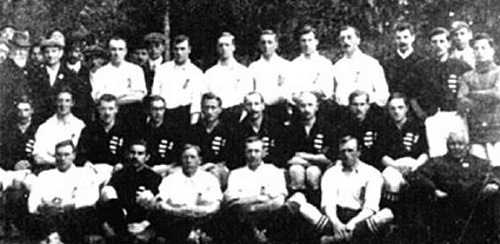 At half-time
the players were marshalled in front of a special enclosure, where the
Burgomaster of the city and numerous other notabilities were accommodated.
Addressing the English players, the Burgomaster expressed the thanks of
Buda Pest to the Football Association, and the team for having honoured
the city by a visit, and he expressed his admiration for the wonderful
ability shown by the team, who had given the Hungarians lessons that they
would take to heart. In the name of the city he then presented to each of
the eleven English players a handsome medal in a case as a memento of
their visit, and as a slight recognition of the great debt of gratitude
that they had placed the city under. Amid a scene of remarkable enthusiasm
he handed the medals to the players, and cordially shook each one by the
hand. At half-time
the players were marshalled in front of a special enclosure, where the
Burgomaster of the city and numerous other notabilities were accommodated.
Addressing the English players, the Burgomaster expressed the thanks of
Buda Pest to the Football Association, and the team for having honoured
the city by a visit, and he expressed his admiration for the wonderful
ability shown by the team, who had given the Hungarians lessons that they
would take to heart. In the name of the city he then presented to each of
the eleven English players a handsome medal in a case as a memento of
their visit, and as a slight recognition of the great debt of gratitude
that they had placed the city under. Amid a scene of remarkable enthusiasm
he handed the medals to the players, and cordially shook each one by the
hand.
The visitors, having established so long a lead, did
not put so much energy into their play in the second half, but the
Hungarians were as persistent as ever, and the crowd cheered itself hoarse
with delight when the home inside-left found the net with a shot made from
twenty yards range. This was neutralised by a sixth goal from Woodward,
who was also responsible for the seventh, and then came more satisfaction
for Hungary, their centre-forward getting clear and given Hardy no chance
with a shot close in. Three minutes from the close Holley obtained the
eighth and last goal, and the game ended.
Thousands lined
the streets from the ground to the hotel where the English players were
staying, and they were continuously cheered for a couple of miles. It was
an extraordinary tribute to the popularity of the English in Hungary, and
it had a deeper significance than the acknowledgement of the skill of
clever football combination.
|
 England
Football Online
England
Football Online
.jpg)



flg.jpg)
 Match
Summary
Match
Summary