England Football Online
Page Last Updated 24 March 2012
 
Players Index
 

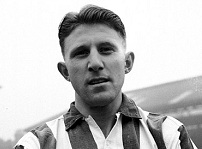
Ray Barlow

West Bromwich Albion FC

1 cap, 0 goals

P 1 W 1 D 0 L 0 F 2: A 0
100% successful

1954

disciplined: none
captaincies:
none
minutes played:
90

Profile

Full name Raymond John Barlow
Born 17 August 1926 in Swindon, Wiltshire [registered in Swindon, September 1926].
Attended Sandford Street School, Swindon
Died 14 March 2012 in Bridgend, south Wales, aged 85 years
Height/Weight 6' 0", 13st. 6lbs [1957].

Source

Douglas Lammings' An English Football Internationalist Who's Who [1990] & FindMyPast.com

Club Career

Club(s) Began his football career as a schoolboy in Swindon. He played for Garrard's FC of Swindon before joining West Bromwich Albion FC as an amateur in June 1944, turning professional in November 1944.  After 403 league appearances, in which he scored 31 times, Barlow joined Birmingham City FC, initially on a month's trial, in August 1960, retiring the following March after just five league appearances. He was however, permitted to play for Stourbridge FC for a further season, finally hanging up his boots in the summer of 1962.
Club honours FA Cup winner 1953-54;
Individual honours Football League (four appearances)
Distinctions None

Source

Douglas Lammings' An English Football Internationalist Who's Who [1990].

England Career

Player number 737th player to appear for England.
Position(s) Left-half
Only match No. 291, 2 October 1954, Northern Ireland 0 England 2, a British Championship match at Windsor Park, Belfast, aged 28 years 46 days.
Major tournaments British Championship 1954-55;
Team honours British Championship 1954-55;
Individual honours England B (two appearances)
Distinctions None

Beyond England

Adevoted family man, he went on to run a tobacconist's and sweetshop inWest Bromwich, then a post office in Stourbridge, always retaining his connection with the club he had served with such distinction and which accorded him a signal honour during its 125th anniversary celebrations in 2004, when he was included in Albion's all-time 16-man squad. - The Independent Obituary, 14 March 2012.


Ray Barlow - Career Statistics
Squads Apps Comp.
Apps
Starts Sub on Sub off Mins. Goals Goals Av.min Comp.
Goals
Capt. Disc.
1 1 0 1 0 0 90 0 0 min 0 None None
Due to the fact that many matches rarely stuck to exactly ninety minutes long, allowing time for injuries, errors and substitutions.  The minutes here given can only ever be a guideline and cannot therefore be accurate, only an approximation.


Ray Barlow - Match Record - All Matches - By Colour of Shirt - By Type of Match
Type P W D L F A GD FTS CS FAv AAv Pts % W/L
Away - White - BC 1 1 0 0 2 0 +2 0 1 2.00 0.00 100.0 +1
All 1 1 0 0 2 0 +2 0 1 2.00 0.00 100.0 +1


Ray Barlow - Match Record - Tournament Matches
British Championships
Type P W D L F A GD FTS CS FAv AAv Pts% W/L
BC 1954-55 1 1 0 0 2 0 +2 0 1 2.00 0.00 100.0 +1
BC Total 1 1 0 0 2 0 +2 0 1 2.00 0.00 100.0 +1
All Tournaments
Type P W D L F A GD FTS CS FAv AAv Pts% W/L
BC 1 1 0 0 2 0 +2 0 1 2.00 0.00 100.0 +1
All 1 1 0 0 2 0 +2 0 1 2.00 0.00 100.0 +1


Ray Barlow - Match History
 Club: West Bromwich Albion F.C. - 1 full cap

Coach: Walter Winterbottom - 1 full capx

Age 25
- b 22 May 1952 - France Espoirs 7 England B 1, Le Havre Fr AL Start 6
Age 26
- b 11 March 1953 - Scotland B 2 England B 2, Easter Road, Edinburgh Fr AD Start 6
Age 28
1 291 2 October 1954 - Northern Ireland 0 England 2, Windsor Park, Belfast BC AW Start 6

Notes

Ray Barlow was a footballing artist, the sweet-passing midfield fulcrum of Vic Buckingham's delightfully free-flowing West Bromwich Albion side of the mid-1950s, and it was not only Baggies loyalists who scratched their heads in perplexity that the stylish wing-half was awarded only a single England cap. Certainly there was no shortage of shrewd observers within the game who reckoned the tall, rangy Wiltshireman preferable to Jimmy Dickinson, the splendidly consistent and defensively ultra-solid Portsmouth stalwart who kept Barlow out during his prime, Dickinson wearing his country's colours 48 times in the process.

As befitted a former inside-forward, Barlow was primarily an attacker, and a gloriously entertaining, endlesslysubtle one at that. His speciality was threading exquisite deliveries through the tiniest of gaps in opposing rearguards, seeming to sense openings which appeared only fleetingly and of which more mundane operators were not even aware.

Often he was the most strikingfigure afield, dictating the tempo of a game with an imperious authority whichcontrasted vividly with his engagingly unassuming character away from the action. Yet for all the elegance of his work on the ball, Barlow was a powerful presence, too, his dynamic box-to-box surges and his strength in the tackle being notable features of his all-round excellence.

Having joined West Bromwich from amateur football in his home county as an 18-year-old in 1944, he was pitched immediately into emergency wartime competition, then made his senior debut in September 1946, scoring from inside-left in a 7-2 victory at Newport County. Midway through 1948-49 he cemented a regular position in the side and, still operating mainly as a forward, scored in the 3-0 win at Leicester in the campaign's penultimate match which was to secure Albion's promotion to the top flight as runners-up to Fulham, the Second Division champions.

Among the élite, Barlow's poise and polish were all the more evident, especially when he settled in his most effective role of left-half, although such was his versatility that sometimes he was pressed into service at centre-half, inside-forward and even centre-forward. His input was never more effective than in 1953-54, when the Baggies were within four points of becoming the first club in the 20th century to achieve the League and FA Cup double, finishing as runners-up to their West Midlands neighbours Wolverhampton Wanderers in the old First Division and beating Preston North End in the Cup final.

Barlow, who was the last Albion survivor from their Wembley line-up, shone brightly in defence and attack under the twin towers, linking up with left-back and captain Len Millard to nullify the potent threat of Preston's fabulous Tom Finney, the newly-crowned Footballer of the Year, and surging forward to earn the penalty from which Ronnie Allen equalised on the way to a dramatic 3-2 victory.

Internationally, though, there was less satisfaction. There were two outings for England B, four for the Football League and an FA tour of South America, but it remained inconceivable to all who placed a high priority on skill and imagination – particularly in an era when England were twice humiliated by the magnificent Hungarians – that Barlow should be limited to 90 minutes in the full national team, the one which beat Northern Ireland 2-0 in October 1954. That day in Belfast he was part of an experimental side containing seven débutants, of whom Johnny Haynes was the only one who would carve out a regular niche, and it seemed to many in attendance at Windsor Park that Barlow and the brilliant Fulham schemer might have forged a fruitful long-term combination on the football fields of the world.

Happily for Albion, his club form was not affected by his country's cold shoulder, and he continued to thrive at the Hawthorns, meshing particularly smoothly with fellow wing-half Jimmy Dudley, deep-lying centre-forward Allen and, as the decade wore on, the attacking midfielder Bobby Robson. In the late 1950s he succeeded Millard as captain, leading them to fourth and fifth in the First Division table in successive seasons before, having reached the veteran stage, accepting a move to second-tier Birmingham City in August 1960.

Not surprisingly, given the accumulation of physical knocks during more than 450 competitive outings for the Baggies, Barlow didn't last long at St Andrew's, moving on to non-League Stourbridge in 1961 after only a handful of appearances for the Blues. Adevoted family man, he went on to run a tobacconist's and sweetshop inWest Bromwich, then a post office in Stourbridge, always retaining his connection with the club he had served with such distinction and which accorded him a signal honour during its 125th anniversary celebrations in 2004, when he was included in Albion's all-time 16-man squad.

If further proof of Ray Barlow'seminence were needed, it came from Sir Bobby Robson, who not long before his death in 2009 described his former Hawthorns comrade as one of the finest players he had ever worked with.Considering that Robson had played for and managed England, then managed Barcelona and Newcastle United among others, that was a meaningful tribute indeed. - The Independent Obituary

____________________

CG