|
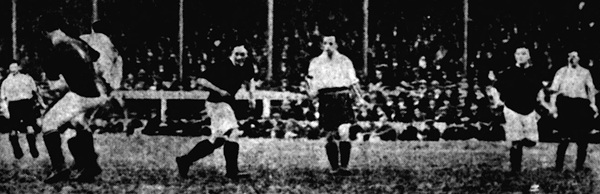
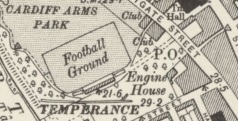
Many 'Rugger' internationals have been played on the famous
Cardiff Arms Park, but very few 'Soccer' games. There was a spice of
novelty for an enthusiastic crowd there this afternoon to see England beat
Wales by a goal to nothing.
.jpg) The weather was delightfully fine,
the sun shining with the power of a June afternoon, and the ground was in
excellent order. The two sides were very good ones, the most notable
absentee in the English eleven being Vivian Woodward. The weather was delightfully fine,
the sun shining with the power of a June afternoon, and the ground was in
excellent order. The two sides were very good ones, the most notable
absentee in the English eleven being Vivian Woodward.
Dr. Roose, the Welsh
goalkeeper. had a narrow escape of being late, a carriage on the 11.30
from Paddington catching fire en route to Cardiff, but, fortunately, the
fire-hose at a wayside station subdued the outbreak. Peake was unable to
play for Wales, and at the last moment Latham, of Southport, took his
place at centre-half.
It was a fast, bright game all
through, and England were the better side, although there was precious
little in it in the first half, when no goals were scored. But for a
couple of bad misses by Wynn and one by Granville Morris, who failed to
score from an open goal, Wales should have been well in front at the
interval. Wales, however, shot their bolt in the first half, and not all
the brilliance of Roose could stop England winning afterwards.
In the first minute of the game, had the referee seen Crompton handle
right in front of goal, Wales might easily have been awarded a
penalty-kick. Hardy made a fine save immediately after, and in a flash
Fleming dashed through and only just missed. After this it was ding-dong
play, with England faster and cleverer, and Wales sticking to their work
splendidly.
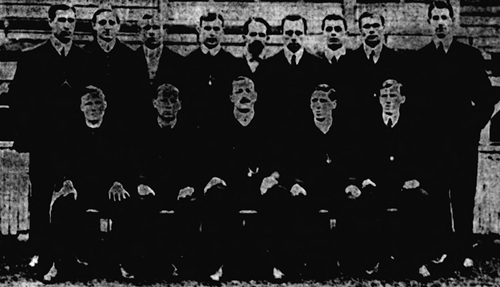 In the second half England had all
the best of matters, and Crompton and Pennington were an almost impassable
barrier to the Welsh forwards. Roose, in the Welsh goal, however, played a
glorious game, until he was beaten from a corner-kick by Ducat after
twenty minutes. He had just previously fisted out shots from Holley, Bond,
and Wall, and Llew Davies had nipped in and cleared when Roose had run out
and failed to stop Parkinson. In the second half England had all
the best of matters, and Crompton and Pennington were an almost impassable
barrier to the Welsh forwards. Roose, in the Welsh goal, however, played a
glorious game, until he was beaten from a corner-kick by Ducat after
twenty minutes. He had just previously fisted out shots from Holley, Bond,
and Wall, and Llew Davies had nipped in and cleared when Roose had run out
and failed to stop Parkinson.
After this Wales
put up a big despairing effort. and Hardy saved a fine shot from Granville
Morris. Then Parkinson beat Roose with a terrific low drive, but Holley
was standing offside and unsighted Roose, and the referee very properly
disallowed the goal. In the last few minutes Crompton thrice saved the
English goal when Meredith had done good work in leading the attack. Once
Hardy was the centre of a Rugby scrum with a dozen players on top of him.
This was the final spurt for Wales, and England won a capital game.
The outstanding feature of the match was the great display of keeping by
Roose. Next to that came the back play of Pennington and Crompton, both of
whom made their places absolutely secure for the Scottish match, and the
terrier-like work to which we are accustomed from little Wedlock at centre
half. Ducat and Bradshaw, the other halves, were moderately good, but
Ducat's goal was a beauty. He also hit the post just after he scored.
The English forwards were fast, but had little understanding. They seemed
to lack a leader, and their individual excellence did not compensate for
combined ineffectiveness. Parkinson, at centre, was the best of the bunch,
but Fleming and Holley were quite disappointing. Meredith when he got the
ball always did good work for Wales, but he was better fed by Roose's goal
kicks than by his halves. The other forwards lost their heads when they
reached the English backs. Latham worked untiringly at centre half, and
Blew and Morris, the veteran Welsh backs, played soundly, if not
brilliantly, Morris once heading out a tremendous shot from Holley.
There were fully 20,000 people present, and although disappointed at the
defeat of Wales they gave both sides hearty applause for all good work.
|
 England
Football Online
England
Football Online


.jpg)



flg.jpg)