|
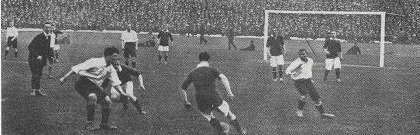
THE PLAY DESCRIBED.
Thomson
won the toss for Scotland, and decided to play with wind and sun behind him.
The wind was blowing straight down the ground with considerable force.
Hardinge and Wall, working together, made good headway. but Law intervened
and sung across to Templeton. The latter eluded Ducat, and when Crompton
essayed to tackle him he fell, leaving the outside left with a clear run
into goal, but he hesitated, and the chance was lost. The next moment the
English forwards, well led by Parkinson, were careering up the field, and
the Liverpool centre concluded a dash, with a hard, low shot that almost
beat Brownlie, the goalkeeper just reaching it by throwing himself full
length. The home team began to tackle, kick, and pass with more confidence
and accuracy. Thomson being especially prominent in spoiling several
well-meant efforts by the English forwards.
During the first ten minutes the
exchanges were certainly in favour of the visitors, whose forwards
flattered only to subsequently deceive, and the halves held the opposing
attack in clever fashion. The clever Celtic pair on the right first
threatened serious danger on the English position, and Hardy was called
upon to save a fine shot by McMenemy. Brownlie at the other end being seen
to great advantage a mater later in repelling a powerful drive by Hardinge.
Next Parkinson, Hibbert, and Bond outwitted the halves and backs, but the
centre-forward in seeking to provide Hibbert with an easy opening put too
far forward, and Brownlie dashed out and kicked away.
Play
now veered round strongly in favour of the home country. Their forwards
started the kind of game that enabled them to achieve such a fine victory
at Blackburn, and the English defence did not meet it in the proper way.
Templeton, one of the most showy players in the four countries, found a
partner exactly to his liking in Higgins, while on the other wing Bennett
and McMenemy were working with a precision that kept the English defence
constantly on the qui vive.
After Hibbert had broken
through and shot wide, Templeton again delighted the crowd with his
elaborate movements, but he frequently overdid the the gallery work, and
consequently enabled the the English defence to drop back and deal with
any attempts to score that followed his centres. Hardy, however, was more
than once called upon, and he did not field so smartly as usual. At then
end of twenty minutes the first disaster befel England, Bond was taking
the ball up the right wing when he was tackled, and McWilliam, getting
possession, sent on to Quinn, with the result that Pennington missed his
kick, and Crompton, in endeavoring to clear slipped and fell. Quinn went
on, and Hardy rushed out and intercepted the shot, but went down in doing
so, and ere he could rise to his feet McMenemy pounced on the ball, and
quietly directed it towards the net, Ducat, who made a great dash across
the goal, having the mortification to miss reaching it by about a foot,
and Scotland consequently took the lead.
From this point
England were really a beaten team. They tried hard to equalise, but there
was no sting in their finish, and in the open the smart combination which
was so encouraging in the opening stages was not reproduced. Thomson, at
centre-half, was playing a great game for the home country, and he held
Parkinson as securely as Wedlock held Quinn, but as the home centre could
not make such progress, the wings were assiduously fed, and they were as
smart, and adapted themselves so thoroughly to each other's play that
Ducat and Makepeace, and behind them, Crompton and Pennington, had
scarcely a moment's rest.
Over ten minutes of the first
half remained when an exultant about from the crowd heralded a second goal
for Scotland. It occurred in this way: McWilliam sent across to the centre
when Thomson was beaten, and robbing Hardinge, went off on his own, and
then sought to give a long pass to Bennett, who was standing in an offside
position. Pennington lunged at the ball, but only diverted it straight to
the waiting Bennett, who made tracks for goal. Crompton rushed across, and
Bennett pashed to Quinn, who attempted to get through. There was a mix-up
in the goal-mouth, and with Hardy on the ground Quinn had only to touch
the ball into the net and the home country had a two goals lead.
Encouraged by their success, the Scottish forwards played with boundless
energy, and their mathematically accurate passing kept the English defence
busy. It held out, however, and Scotland left the field at the interval a
couple of goals to the good.
The second half opened
auspiciously for England, as with the wind in their favour they promptly
dashed down, but Brownlie was not seriously troubled. The ball did not
long remain in the vicinity of the Scottish goal, as Law come to the
rescue, and Bennett and McMenemy opened up an attack that was ended by
Higgins putting past the post from a square centre by the outside right.
The next incident of interest was a free kick for the home country,
following which various shots were directed at the English goal, but they
were not really dangerous, though once Hardy cleared in half-hearted
fashion, and he had to follow the ball well into the field to prevent
McMenemy taking a pot shot at goal. There was an improvement on the part
of the visitors, and both Bond and Parkinson flashed in rising oblique
shots that cleared the bar by a foot, but the wished-for goal would not
materialise.
For a period of about ten minutes the
representatives of the Rose more than held their own, but their was always
a lack of incisiveness when in the neighbourhood of Brownlie, and also a
woful lack of determination. A couple of corners were not improved upon,
and a trio of similar concessions to Scotland at the other end were also
fruitless, although Quinn got his head to a delightful flag-kick by
Bennett, and the ball missed the posts by only a few feet. Once more
England essayed to reduce the lead against them, a well-sustained attack,
in which Wedlock and Ducat bore a prominent part, taxing the resources of
the Scottish defence, but the latter prevailed. It appeared likely the
next minute that the scoring would be at the other end, as Templeton
rounded Crompton, and with only Hardy to beat steadied himself and then
shot a dozen yards wide.
The concluding stages were
somewhat tame, but there were incidents that kept interest alive until the
end. There was some really excellent wing to wing passing on the part of
the English forwards, and this provided Wall with an opening. He secured
the ball, dashed in, and shot hard and straight at Brownlie, who cleared
in nonchalant fashion. There was a rally towards the close on behalf of
England by Hibbert and Bond, but they were beaten off, and Scotland had
two corners, neither of which was improved upon. In the final two minutes
the home country kept the ball in the England half of the ground, and the
end came.
|
 England
Football Online
England
Football Online



flg.jpg)